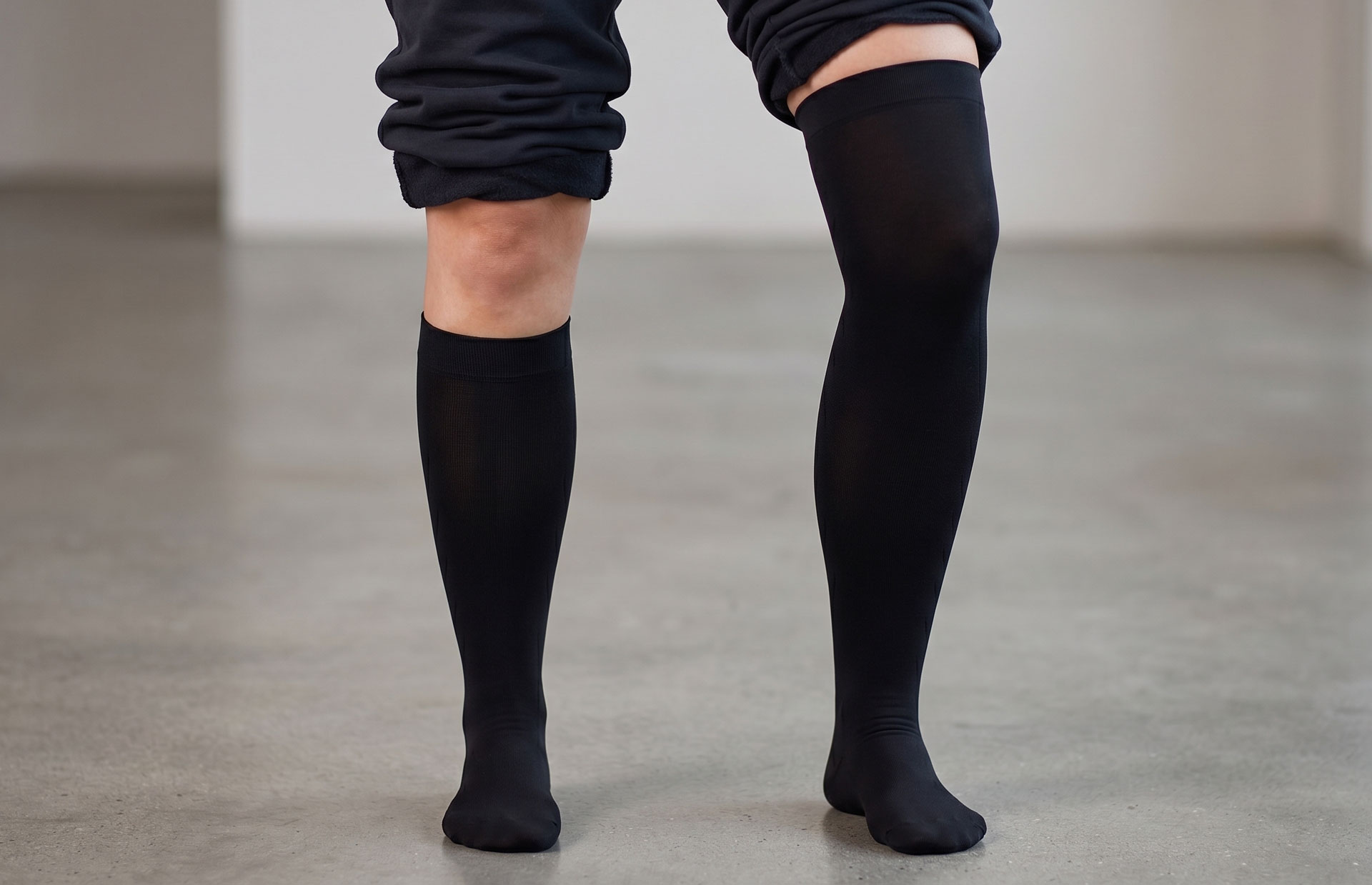
Thigh-high compression socks can help tired, swollen legs by gently squeezing the legs and promoting blood flow upward toward the heart. They may ease symptoms of varicose veins and venous insufficiency, but they do not repair weak valve function in the veins. Knee-high stockings work for many people, while thigh-high compression socks may be useful when swelling or vein symptoms extend above theknee. A vein specialist can help you choose the right length and pressure.
Medical Disclaimer: This article is for general education only. It is not a diagnosis or treatment plan. Always talk with a qualified healthcare professional before starting compression therapy, especially if you have diabetes, peripheral artery disease, skin wounds, severe leg pain, or a history of blood clots.
If you have achy legs, swelling, or visible varicose veins, you may wonder if thigh-high compression socks are worth trying. The answer is often yes, but with limits. Compression can support circulation during the day. It can also help with heaviness and swelling.
But compression is not the same as vein treatment. At Vascular & Interventional Specialists of Alabama, we evaluate patients for venous reflux, varicose veins, swelling, and other vein problems so we can address the real cause.
How Do Compression Stockings Work?
Compression stockings squeeze the leg from the outside. Most medical compression is graduated. That means the pressure is strongest near the ankle and lighter as it moves up the leg.
This pressure helps veins and calf muscles move blood upward. It may also reduce fluid buildup in the lower legs and feet. MedlinePlus explains that compression stockings improve blood flow in leg veins, reduce swelling, and help prevent some blood clot problems after surgery or injury when a person is less active.[1]
Compression socks do not create new valves inside your veins. If the valves are weak or damaged, blood may still flow backward and pool. This is called venous reflux. Compression can help manage symptoms from venous disease, but it may not fix the source of the problem.
Do Compression Socks Help With Varicose Veins?
Compression socks can help relieve varicose vein symptoms. Many people notice less heaviness, aching, and ankle swelling when they wear them during the day.
They may be especially useful if you sit for long hours, stand at work, travel often, or have mild swelling that gets worse by evening. Cleveland Clinic notes that compression therapy helps improve circulation in the lower legs, ankles, and feet and can help with pain and swelling from chronic venous insufficiency and varicose veins.[2]
Still, varicose veins happen because pressure builds inside veins with weak valves. Once a vein is enlarged and refluxing, compression usually will not make it disappear. If veins are painful, bulging, warm, bleeding, or linked with skin changes, it is time to ask about varicose vein and venous disease treatment.
Knee High vs Thigh High Compression Stockings
Knee-high compression stockings stop below the knee. They are easier to put on and work well for many people with ankle swelling, calf heaviness, or lower-leg vein symptoms.
Thigh-high compression socks extend above the knee and cover more of the leg. Consider them when swelling, varicose veins, or vein symptoms continue into the thigh. Some people also use above-the-knee compression socks after certain vein procedures, if their provider recommends them.
Fit matters more than length alone. A stocking that bunches behind the knee or rolls down the thigh can pinch the skin and block healthy flow. If your socks leave deep painful marks, cause numbness, or feel much tighter in one area, remove them and call your clinician.
How Long Should You Wear Compression Socks?
Most people wear compression socks during waking hours. A common plan is to put them on in the morning before swelling builds and take them off before bed. Cleveland Clinic gives similar advice, noting that people often get the most benefit by putting compression stockings on in the morning and removing them before bed or after exercise.[3]
Your plan may be different after surgery, during pregnancy, after a clot, or after a vein procedure. Follow your provider's instructions.
Put them on before swelling starts
Compression is easier to apply when your legs are less swollen. For many people, that means first thing in the morning.
Wear them during the part of the day that triggers symptoms
If your legs hurt after standing, wear them during work. If your swelling shows up after sitting, wear them during travel or desk time. If you use compression socks for exercise, remove them after your workout or recovery period unless you were told otherwise.
Remove them at night unless you were told not to
Most daily compression socks are not meant to be worn all night. Skin needs a break. Sleeping in compression socks can also be unsafe for some people if pressure is too high or the fit is wrong.
Who Should Not Wear Compression Socks Without Medical Advice?
Do not guess if you have a circulation problem. People with peripheral artery disease, severe nerve damage, fragile skin, untreated infection, open wounds, or severe pain should ask a clinician before using compression.
Cleveland Clinic warns that people with peripheral artery disease need to be careful with compression therapy and may be told not to use it, depending on the condition.[4]
Stop and call for help if compression causes numb toes, blue or pale skin, new severe pain, or sudden swelling in one leg. Compression socks do not replace urgent care for a possible blood clot.
How to Put On Compression Stockings
Start with dry skin
Dry your legs first. Do not apply lotion right before putting on tight stockings unless your provider said to use a specific product.
Turn the stocking inside out to the heel
Place your foot into the toe and heel area first. Then slowly pull the stocking up over the ankle and calf.
Smooth the fabric as you go
Wrinkles can press into the skin. Smooth the stocking to keep pressure even. Do not fold the top band down.
Use a donning aid if needed
If hand strength, arthritis, or back pain makes compression hard to use, ask about a stocking doner, rubber gloves, or a different style.
Compression Helps, But It May Not Be the Whole Answer
Compression stockings can be a good first step. But if your legs still ache, swell, throb, itch, or show bulging veins, the problem may be deeper than tired legs.
The venous disease team at Vascular & Interventional Specialists of Alabama offers minimally invasive procedures in Birmingham and Pelham for vein problems, including venous reflux and varicose veins. Their location is also listed on Google Maps for patients looking for local care.
Frequently Asked Questions About Compression Socks
- How long should you wear compression socks? - Many people wear them during the day and remove them before bed. Your provider may give different instructions after surgery, a clot, pregnancy, or a vein procedure.
- Can you wear compression socks all day? - Yes, many people can wear them all day while awake if they fit well and were chosen correctly. Do not wear them nonstop without guidance.
- Are compression socks supposed to be tight? - They should feel snug, not painful. They should not cause numbness, tingling, blue toes, or deep pinching.
- What does mmHg mean in compression socks? - mmHg means millimeters of mercury. It is the pressure rating. Higher numbers mean stronger compression.
- Do compression socks help with blood clots? - They may be used in some clot prevention and recovery plans, but they do not treat a new clot by themselves. Sudden one-sided swelling, warmth, redness, or calf pain needs medical evaluation.
Conclusion
Thigh-high compression socks can help with swelling, heaviness, and tired legs. They may also help control symptoms of varicose veins and venous insufficiency. But if your symptoms keep coming back, compression may be managing the signs without treating the cause. To find out whether vein disease is behind your leg symptoms, schedule a vein consultation.
Medical Disclaimer: This article is for general education only. It is not a diagnosis or treatment plan. Always talk with a qualified healthcare professional before starting compression therapy, especially if you have diabetes, peripheral artery disease, skin wounds, severe leg pain, or a history of blood clots.
References
[1] MedlinePlus. Compression stockings. https://medlineplus.gov/ency/patientinstructions/000597.htm
[2] Cleveland Clinic. Compression Therapy. https://my.clevelandclinic.org/health/treatments/23449-compression-therapy
[3] Cleveland Clinic. What To Know About Compression Socks. https://health.clevelandclinic.org/what-you-should-know-about-compression-socks
[4] Cleveland Clinic. Chronic Venous Insufficiency. https://my.clevelandclinic.org/health/diseases/16872-chronic-venous-insufficiency-cvi